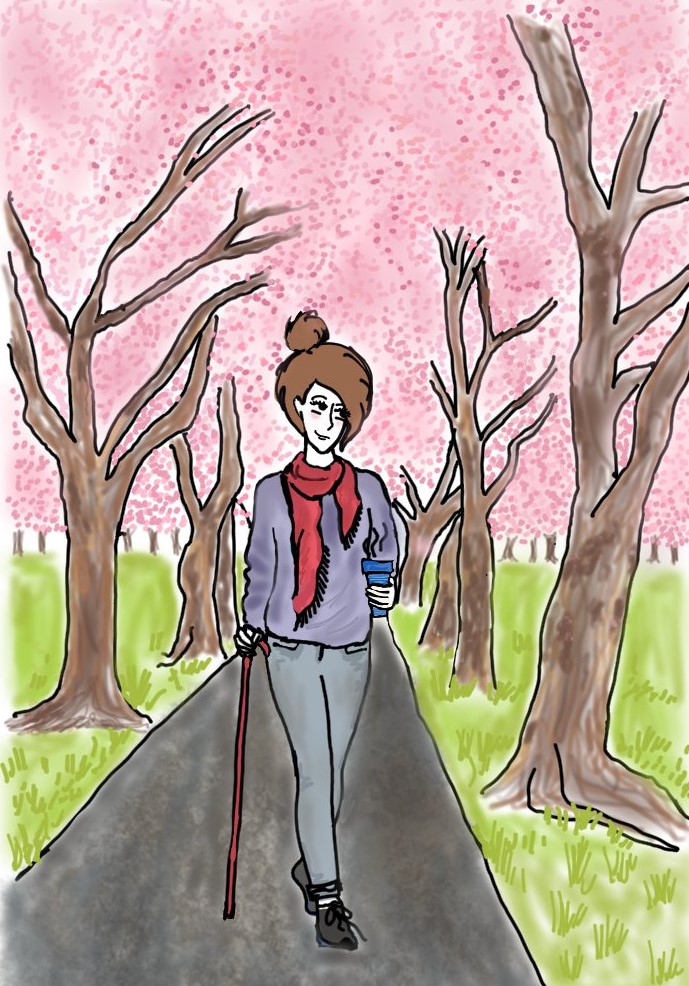
It’s one of my favourite times of year, springtime. Colour returns as flowers burst into full bloom. The days are getting lighter and the evenings stretching on for longer, with summer on the brink of our horizon. As Covid restrictions ease there is a feeling of optimism in the air; hope returning, as the prospect of seeing loved ones is once again possible.
As an Endometriosis patient, this March has special meaning for me. Not only is it Endometriosis Awareness Month, but it’s the first month in 2021 that I’ve been able to walk without the assistance of a walking stick.
I had my most recent surgery in November and was flat-bound for several weeks due to the recovery period and my inability to walk down the long stairwell that makes up our block of flats. Having an operation during Covid-19 was a very surreal experience and one which I’ll never forget, especially as it required pre-surgery isolation (post-surgery isolation was also vital to protect the body with its lowered immunity – yet the latter period was much less of a challenge given I was bedridden for most of that duration!)
As a result, I spent the last few months of 2020 at home in our flat. Again this was quite a bizarre experience, as I generally have little need for public transport and so am used to walking long stretches each day.
During what felt like endlessly long days alone, I kept thinking back to the visual depictions in Edward Hopper’s paintings, in particularly Morning Sun (1952). There is something so tranquil about his use of light and space, which very much captures the sense of isolation within the enclosed interior.
The other thing I kept thinking about and returning to throughout this period of isolating, was Olivia Laing’s book The Lonely City. It’s a semi-autobiographical text which reflects on her experiences of loneliness after moving to New York from England, and explores the lives of artists in similarly solitary situations. It is by far one of my favourite books and offers a very interesting discussion of artists such as Warhol, Hopper and several others. In particular, this section kept replaying in my mind;
‘The city reveals itself as a set of cells, a hundred thousand windows, some darkened and some flooded with green or white or golden light. Inside, strangers swim to and fro, attending to the business of their private hours. You can see them, but you can’t reach them, and so this commonplace urban phenomenon, available in any city of the world on any night, conveys to even the most social a tremor of loneliness, its uneasy combination of separation and exposure.
You can be lonely anywhere, but there is a particular flavour to the loneliness that comes from living in a city, surrounded by millions of people. One might think this state was antithetical to urban living, to the massed presence of other human beings, and yet mere physical proximity is not enough to dispel a sense of internal isolation. It’s possible – easy, even – to feel desolate and unfrequented in oneself while living cheek by jowl with others. Cities can be lonely places, and in admitting this we see that loneliness doesn’t necessarily require physical solitude, but rather an absence or paucity of connection, closeness, kinship; an inability, for one reason or another, to find as much intimacy as is desired’.[1]
I re-read chapters of this book whilst making endless cups of tea, the filling of the kettle an oddly satisfying way to punctuate the long days spent alone. The Lonely City is a book I’ve returned to many times over the years, but it took on a new meaning following last year’s lockdown experiences. I’m sure many people, particularly those living in smaller spaces, felt the same as Olivia Laing describes. Although I was not in the category of those shielding throughout the pandemic, the pre-operation isolation gave me a glimpse into the shielding lifestyle people were forced to inhabit.
I spent long moments with my windows open, leaning out and hoping to catch the breeze on my cheeks. I watched the street below, people hurrying along the pavement, masks on, masks off. I watched the vegetables slowly decrease in quantity from the shop across the road, as people came and went with their purchases throughout the day. I watched the sun cast long shadows on the bricks of the building opposite, how they changed as evening light crept up.
I watched clouds pass over, listened to the hum of buses, watched cigarette smoke curl up as shop assistants took their breaks. Through my inability to leave the flat, I was subconsciously absorbing more details of my everyday. Yet I couldn’t help but feel separate, the pane of glass that existed between myself and the outside world at times felt like a momentous barrier; enclosed and trapping.
For those living with Endometriosis (and many other chronic illness patients) there are times where you experience a sense of feeling trapped in your own body. A musculoskeletal prison from which you can’t exit; inevitably bed bound on bad days, or forced to spend a weekend in hospital. I find the unpredictability from day to day to be by far one of the biggest challenges of living with a chronic illness.
***
Returning to the use of a walking stick; I vividly remember the first time I had to use one. It was many months prior to surgery, and I was suffering severe sciatica at the time. I felt so much shame in having to admit I needed one and slight horror when it arrived in the post. Could I use this in public? What would people think? How many looks would I get? For someone in their mid-twenties, a walking stick is not something you expect to become an essential component of your wardrobe.
Inevitably I was right about the looks. Acutely aware as I crossed the roads with waiting cars. Young children shot me quizzical expressions, adults looked me up and down; face to boots and back again. People hurried past, almost knocking me into puddles or off the pavement edges. Cue lots of tripping over nothing and clumsy pavement dances as I did my best to avoid passers by.
With time, I grew accustomed to the enquiring looks and crossing roads alongside elderly people with walking sticks. The walking stick became so essential on bad pain days, that I eventually stopped noticing those who were curiously staring. All I noticed was the pain relief that leaning on a stick gave me – and much more so after my surgery. Following the operation, I needed the stick for everything; getting out of bed, making food in the kitchen, getting up from the sofa. It became such a necessity across those weeks that I began to feel naked without it [2].
I’m now four months post-surgery and finally able to walk without aid again. It is an indescribable feeling of freedom. I can walk fast again, longer distances, adhere to my estimated walking times. For someone who rarely takes public transport and walks everywhere on foot, it felt unbelievably liberating to return to this state of myself. Walking has always been essential to my creativity and inspiration – discovering new alley routes through the city, interesting architecture, walking alongside waterways.
As I regained mobility, I set myself a target of walking 10km a week as part of Endometriosis UK’s 1 in 10 challenge. Happily I have surprised myself and been able to walk 10km a day across weekends, which has been such a pleasure. As Emilie Pine reflects,
‘My body is healthy, it has survived some challenges. It is a body which makes me feel good more than it makes me feel bad.
My body enables me to do things’[2].
Our bodies are resilient and although living with a chronic illness is certainly tough at times, it has taught me to embrace what I can’t control and rejoice in the small successes.
***
If you are interested and/or able to donate even a couple of pounds (I know we’re living in extremely tough financial times) to my fundraiser for Endometriosis UK’s 1in10 challenge, there are just a few days left to give: https://www.justgiving.com/fundraising/allaboutendo
[1] Olivia Laing, The Lonely City, 2017, p.3-4
[2] For any Endometriosis patient reading this and about to go into surgery, I would highly recommend using a walking stick to alleviate the pressure and use of any muscles in the operated area. Mine was from WalkingSticks.co.uk which offers very affordable (and fashionable!) options – many of which can be deconstructed and folded up to fit in a bag.
[3] Emilie Pine, Notes to Self, 2018
[Image description: Camilla is wearing a lilac sweater with a red scarf around her neck, grey jeans and black trainers. She is holding a thermos of coffee and is walking with the assistance of a red walking stick. Her brown hair is tied up in a bun and she is smiling as she makes her way down a corridor of blossom trees. These are blooming their pink flowers which make up the background – alongside a grey pavement in amongst stretches of grass.]
 allaboutendo