This is a post relating to the recent blocking of accounts and comments relating to Endometriosis content across Instagram.
Thursday night I tried to post an image on Instagram with a caption relating to the same content in my previous blog post – the use of a symptom diary to help track symptoms. In the post I discussed the necessity of a symptom tracker as an Endometriosis patient in the interim between surgery; the necessity of tracking medication start dates and times, as well as the beneficial aid of a symptom diary to help negotiate the more challenging medical appointments or the start of any new prescriptions.
Repeatedly I received the notice ‘we restrict certain activity to protect our community’. The image could be posted, but the comment was erased. I tried again on Friday morning, only to find the same issue was occurring. Following that and searching for information about these restrictions, I discovered that several Endometriosis-Awareness accounts that I follow had been blocked and several other accounts were experiencing the same comment erosure. The word ‘Endometriosis’ and linking to the charity Endometriosis UK (under the handle of @endometriosis.uk) has caused posting issues. During Endometriosis Awareness Month – a month in which we are all doing our best to share informative Endometriosis content and further awareness of this chronic condition.
My post and others’ did not to my knowledge breach any of the Instagram guidelines and I am yet to hear back from Instagram as to how they did. Myself and fellow members of the Instagram Endometriosis community are dismayed, upset and shocked at the content blocking, particularly as our content is designed to inform and support others living with and wanting to learn more about this health condition.
A recent BBC article mentioned ‘patients have repeatedly reported to the BBC that they have felt overlooked when talking to doctors about conditions like endometriosis or complications following a pelvic mesh repair.’[1] Women’s health has always, if not often, been a taboo issue.
Throughout history women’s pain has been ignored, patients have constantly been labelled hysterical with many things blamed on their hormones and the general public rhetoric surrounding menstruation is embarrassment, shame and silence. When fighting for an Endometriosis diagnosis – and yes, I use the word fighting which I will come on to in a moment – Instagram became an absolutely vital platform to me. I found other patients who had received their diagnosis, shared tips on what to bring into hospital for operations, suggestions on effective pain relief. If it hadn’t been for people I follow on Instagram, I wouldn’t have cut gluten and dairy out when I did. I wouldn’t have learnt about excision surgery, found out about the benefits of pelvic floor physio, how sciatica presents across various patients and many other countless and vital pieces of information on the condition. I have so many amazing accounts that I follow, all from patients who have bravely shared their experiences of living with Endometriosis and who I am incredibly grateful to have learnt from through this online community.
And yet these accounts were recently restricted, blocked, denied access, with numerous Endometriosis related comments removed or prevented. During Endometriosis Awareness Month – the one month of the year in which this community, alongside amazing charities such as Endometriosis UK, are doing our best to bring public attention to the necessity of furthering funding, awareness and research into this health condition. The severe disappointment – yet sadly also the lack of surprise – that this content filtering has occurred, is just another instance which proves how much further we still have to go as a society in terms of furthering gender equality.
Going back to the fighting for a diagnosis; there is a reason the Endometriosis community refers to its patients as ‘endo warriors’. This is not only because it is one of the top twenty most painful diseases, but it is also because we have to fight and battle to be believed with our illness. The amount of times I repeatedly returned to doctors with symptoms of Endometriosis, only to be dismissed were countless. Here are some of the things that were said during those appointments:
“You don’t have Endometriosis”
And yet this doctor had nothing confirmed through referrals, tests or the usual diagnostic laparoscopy.
“You’re too young to have sciatica”.
And yet no investigation was performed and I was recently told by a specialist during a bad sciatic flare up that any one of any age can exhibit symptoms of sciatica.
“It’s just a bad period”
An instance where I lost so much blood that again I found myself back in A&E.
This is just a snapshot of the instances I have experienced with doctors. Similar cases have been found across many other Endometriosis patients. In a BBC study conducted on living with Endometriosis, out of the 13,500 participating patients, more than 50% admitted to experiencing thoughts of suicide as a result of living with this condition [2]. Now, that is an incredibly worrying and high statistic. Couple that with the 7.5yr average diagnosis timeline, as well as the dismissive medical professionals, alongside the recent blocks and censoring on Instagram – it is no wonder.
Patient dismissal and ‘taboo’ subject matters need to be a thing of the past in order to effectively treat this chronic condition, prevent the diagnosis delay and subsequent prolonged patient suffering. We live in an era of information circulation and supposedly female liberation. Yet the censoring of multiple Instagram accounts during Endometriosis Awareness Month proves otherwise. As with all the awful medical appointments we’ve experienced as Endometriosis patients, it proves that we as women are and still continue to be silenced.
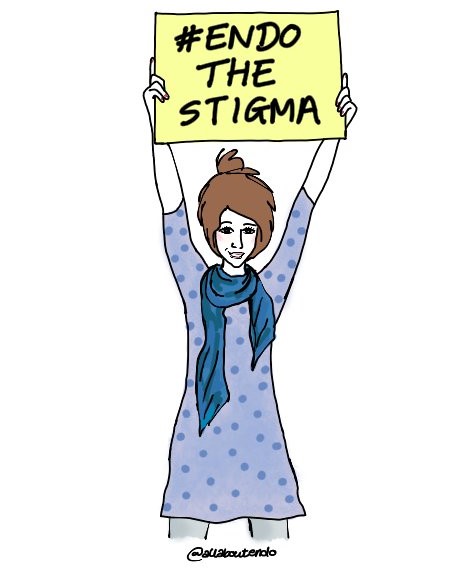
[Image description: Camilla stands holding a yellow banner above her head which reads ‘#Endo the Stigma’. She wears a pale blue dress with lilac polka dots, as well as a navy blue scarf wrapped round her neck. Her brown hair is tied up in a messy bun and she is smiling.]
[1] BBC News, Women’s health: Female patients to be asked about ‘gender health gap’, March 2020, https://www.bbc.co.uk/news/health-56300404
[2] BBC News, Endometriosis: Thousands share devastating impact of condition, Oct 2019 https://www.bbc.co.uk/news/health-49897873
 allaboutendo