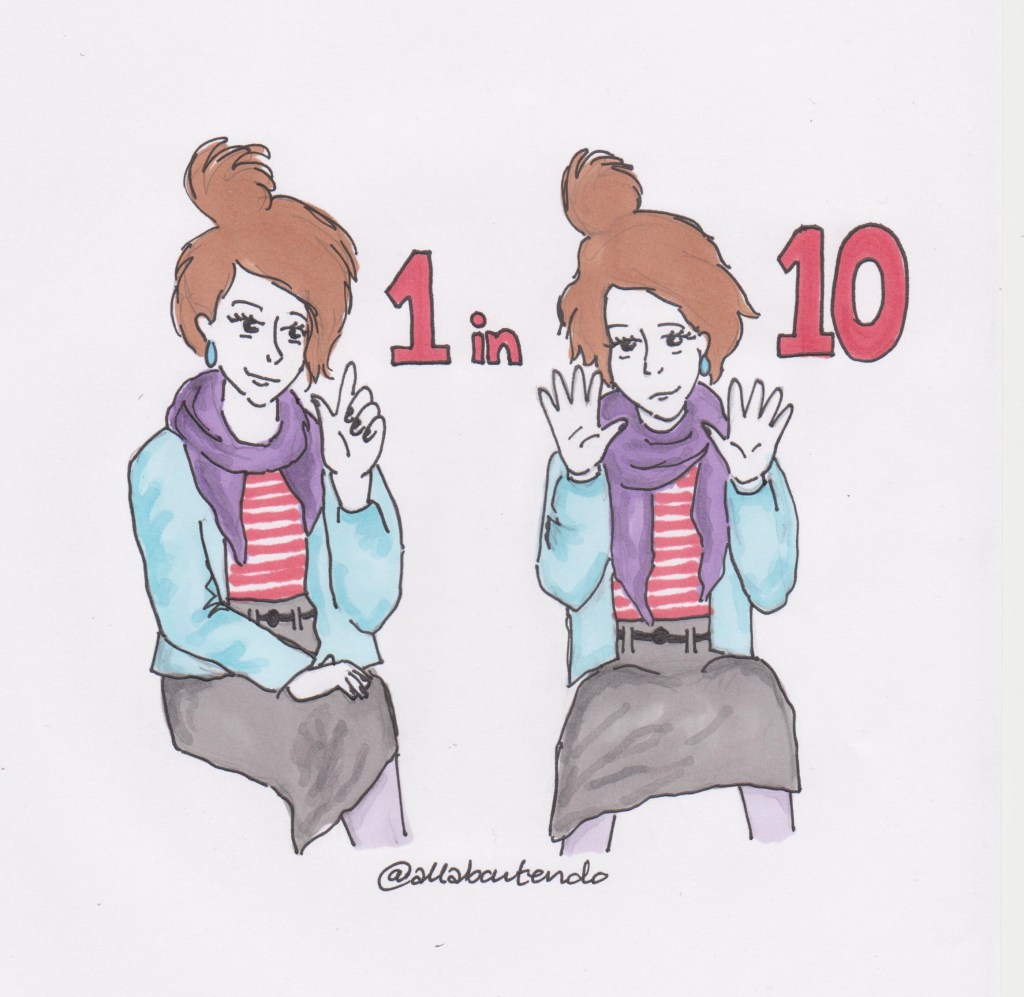
One in ten women suffer from Endometriosis*.
One in ten.
Think back to school, the average class size. Arrays of students lining hallways as they extract textbooks from their lockers. Think of office buildings; collections of desks joined together with multiple keyboards being tapped endlessly. Think of University lecture halls, the rows of desks filled with listening students. Think of standing in the queue for coffee, a long line of cappuccino, latte, Americano, flat white, recited from those waiting. Think of the staff on their feet behind the counter, rushing to fulfil orders to avoid customer impatience. Now think of the statistic – one in ten in each of these spaces will be an Endometriosis patient.
I remember reading that statistic for the first time – I didn’t have my glasses on. Frantic scramble to find said glasses ensued. Re-read the fact. For once I’m dismayed it’s not my eyesight betraying me.
When it was first suggested I might have Endometriosis, I had never heard of it. Queue a brief overview from the GP followed by the inevitable Googling when I got home.
Quick breaths, make tea, new search.
By the time I finished my eyes were glazed with articles, numbers, tissue facts and a numbing realisation that this may in fact be my problem. I resolved not to panic until I was formally diagnosed. A few months later, I had the diagnostic laparoscopy – the only current method to formally diagnose Endometriosis.
Post-op I was high on morphine, anaesthetic and various other liquids received through my cannula. I don’t remember much about my surgeon coming to discuss the outcomes of the operation with me, other than the fact that Endometriosis was indeed confirmed.
Looking back at the time of diagnosis now, I don’t think it really sunk in properly. I continued with my routine and daily life. Inevitably the illness began to creep up on me, like a late evening shadow, yet I rebuffed it and allowed it to settle on the periphery of my mind. I tried not to think too much about pre-Endometriosis me and post-Endometriosis me. I thought the impact on my life would be manageable with surgery – that it would be the ultimate solution. However, I now believe that was largely down to the lack of information I was given throughout diagnosis, which was and continues to be incredibly problematic for patients with my condition. Although knowledge of Endometriosis is evolving all of the time, treatment and patient support is not.
Generally when patients are diagnosed with a long term health condition, all the possible symptoms and treatments are suggested; along with the various side effects. Yet largely when it comes to Endometriosis, patients are left to figure out many aspects and care pathways by themselves – mainly through trial and error – an assortment of prescribed pain medication, dietary changes and even job alterations. This along with multiple trips back to the doctor, or in my case multiple A&E admissions alongside.
Although Endometriosis can present in the form of sciatic, nerve pain and digestive problems (amongst various others), most patients are only medically informed of the gynaecological implications. This results in patients experiencing symptoms they don’t understand, didn’t expect and certainly don’t have the medical knowledge to manage. The diagnosis journey is a vital component of learning to live with a chronic condition, yet how can the patient fully understand their diagnosis when they are not given all of the information and possible symptoms? This is an element of Endometriosis care which needs radical change, especially given the fact that diagnosis timelines are still an average of 7.5 years**.
Thankfully, 2020 saw a turning point in sex and menstrual health education in England; although sex education has been compulsory there since 2017, the curriculum was limited as many aspects weren’t compulsory teaching***. Amongst various other new curriculum components, it will now be the case that menstrual health and menstrual cycle teaching will begin in primary school – thus leading to heightened awareness of what period symptoms are considered normal and highlighting others which may be a cause for concern. This heightened awareness and knowledge will therefore lead to patients seeking medical help sooner, being diagnosed with Endometriosis at a younger age and in turn reducing the long-term damage to their bodies.
Brilliant news, as education is vital to battling this chronic condition, but still not good enough. This is merely a step towards positive change, but a small step given how much more is needed and considering Endometriosis affects every one in ten.
*Rogers PA, D’Hooghe TM, Fazleabas A, et al. Priorities for endometriosis research: recommendations from an international consensus workshop. Reprod Sci 2009;16(4):335-46.
**Endometriosis UK, https://endometriosis-uk.org/endometriosis-facts-and-figures
***BBC News, Sex education: Menstrual health to be taught in school by 2020, 25 Feb 2019
[Camilla is sat wearing a pale blue cardigan, striped pink and white tip, purple scarf and grey ¾ length skirt alongside lilac tights. She has brown hair tied up in a bun and has blue earrings in. She is sat with one arm down and the other arm raised slightly so that her hand holds up one finger. Another Camilla sits alongside wearing the exact same outfit but holding up ten fingers with palms facing forwards. Pink graphic text is included reading 1 in 10.]
 allaboutendo
I like the drawing of Camilla 1 & 2…
LikeLike